
Applying Artificial Intelligence in Vocational Schools: A Significant Challenge 13
GD&TĐ – Many vocational schools are applying artificial intelligence in teaching and management, opening up opportunities to improve training quality, personalize the learning process, and optimize operational workflows.
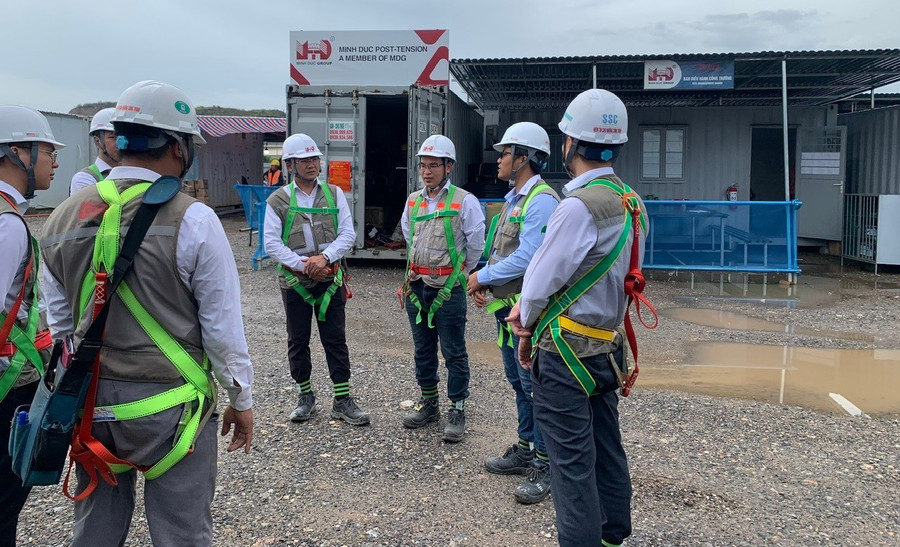
Mr. Tran Dai Nghia (fourth from the left) – General Director of Minh Duc Construction Group, discussing with engineers at the construction site. Photo: Courtesy of the source
However, vocational institutions are still facing numerous challenges, ranging from limitations in infrastructure and investment costs to lecturers’ capacity and an incomplete legal framework.
Stepping up the application of technology
From the beginning of the 2025–2026 academic year, Ho Chi Minh City International College has officially applied artificial intelligence (AI) in management and teaching, aiming to improve training quality and meet practical demands for digital transformation in education.
Mr. Nguyen Dang Ly – Principal of the college, said: “During the summer break, we organized AI application training for all staff, employees, and lecturers. Prior to that, the college had established a core faculty group to research and practice AI applications in lectures, student management, and office workflow optimization.”
Not stopping there, Ho Chi Minh City International College has also cooperated with a technology company to develop a student management application covering the entire process from enrollment to graduation. This application helps lecturers and the board of management monitor learning progress, enables parents to track academic results and attendance, and detects early students at risk of dropping out.
Based on this, the college works with parents to identify causes and support students in overcoming difficulties, thereby reducing dropout rates. In addition, the application provides reminders for tuition payment schedules, class timetable changes, and alerts for weak modules, helping students take a more proactive role in their studies.
“Applying AI to management and teaching is like conducting an in-depth examination to identify learners’ strengths and weaknesses. From there, we can design appropriate lectures and teaching approaches,” Mr. Nguyen Dang Ly shared.
Today’s industries are undergoing strong digital transformation. Applying AI helps save costs while improving accuracy and work efficiency. Therefore, learners who gain early access to modern technology will reduce retraining costs for enterprises and increase their employment opportunities after graduation.– Mr. Tran Dai Nghia – General Director of Minh Duc Construction Group, commented from a business perspective.
In reality, many young workers entering the labor market still lack practical skills and process-oriented thinking, forcing enterprises to retrain them from scratch, which directly affects work progress. This leads many businesses to hesitate in recruiting inexperienced candidates or to offer low starting salaries to new graduates.
In the construction sector, when technology is integrated into teaching, students have opportunities to access virtual simulations of construction sites, occupational safety training, and more. The learning process does not require students to excel from the outset, but rather to master basic procedures. As a result, when entering real-world environments, students can already visualize possible situations and quickly adapt to their jobs.
“Previously, students’ skill levels depended heavily on individual lecturers, each with different teaching methods, resulting in uneven learning outcomes. Now, applying technology to teaching enables more standardized training; simulations and processes are unified. Learners can identify where they are lacking and which steps have not been performed correctly, allowing timely improvement,” Mr. Tran Dai Nghia emphasized.
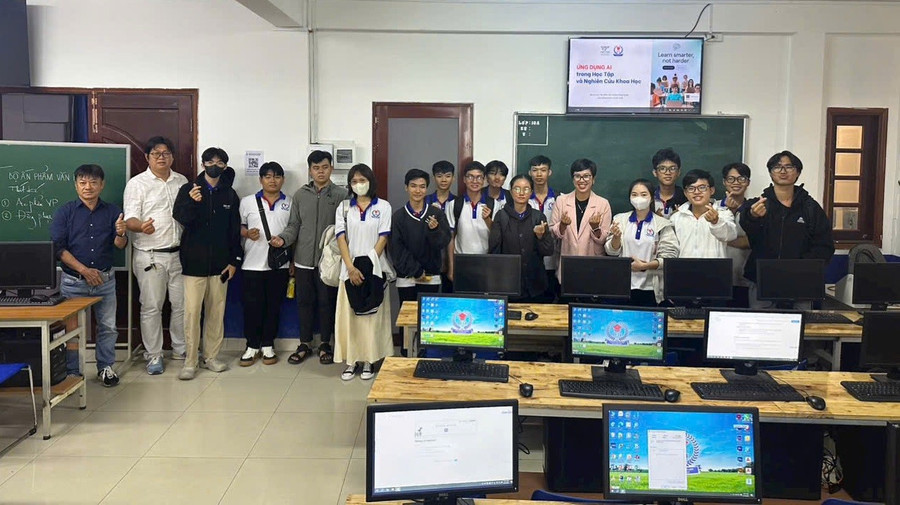
Ho Chi Minh City International College applies AI in teaching. Photo: Courtesy of the source
Challenges from infrastructure to human resources
To apply AI technology in teaching, Hanoi College of High Technology proactively sought funding from the city to invest in infrastructure. As a result, the school’s facilities basically meet the requirements for modern teaching. However, the biggest difficulty remains the lack of uniform learning devices among students, causing obstacles in installing learning software. In addition, legal documents governing activities in the digital environment remain unclear.
Meritorious Teacher, Assoc. Prof. Dr. Pham Xuan Khanh – Principal of the college, shared: “Currently, there are no appropriate guidelines on recognizing training formats conducted in cyberspace, making it difficult to organize fully online training or training in collaboration with enterprises.”
Similarly, Mr. Nguyen Dang Ly noted that many lecturers still follow traditional approaches and find it difficult to adapt to new technologies, while infrastructure investment costs are quite high, limiting the deployment of technology applications in teaching and management.
To address infrastructure and human resource challenges in applying artificial intelligence to teaching, Hoa Sen Vocational College has partnered with many enterprises and technology companies, creating opportunities for students to practice and access modern technologies.
Mr. Le Thien Huy – Principal of the college, said: “Currently, relying solely on the school’s budget to purchase technology and invest in infrastructure is not sufficient. Therefore, if we want students and lecturers to access new technologies in teaching and learning, cooperation with enterprises is essential.
I hope that ministries, agencies, and international organizations, in addition to allocating funds to public institutions, can also provide partial support to non-public schools. This would help schools gain additional resources to invest in facilities and improve training quality. At the same time, there should be an open mechanism allowing vocational schools to collaborate with research institutes and enterprises, creating conditions for students and lecturers to access new technologies.”
“Applying AI in teaching helps lecturers proactively improve pedagogical capacity and research. When technology is introduced into virtual reality classrooms, diverse practice labs, and online learning management systems, students become more engaged, while the learning environment becomes more interactive and fosters creativity.” – Mr. Le Thien Huy – Principal of Hoa Sen Vocational College.
Source: Education and Times Newspaper