
Artificial Intelligence in Vocational Training: Significant Challenges Ahead
Many vocational schools are integrating artificial intelligence (AI) into teaching and management, opening up opportunities to enhance training quality, personalize the learning process, and optimize operational workflows.
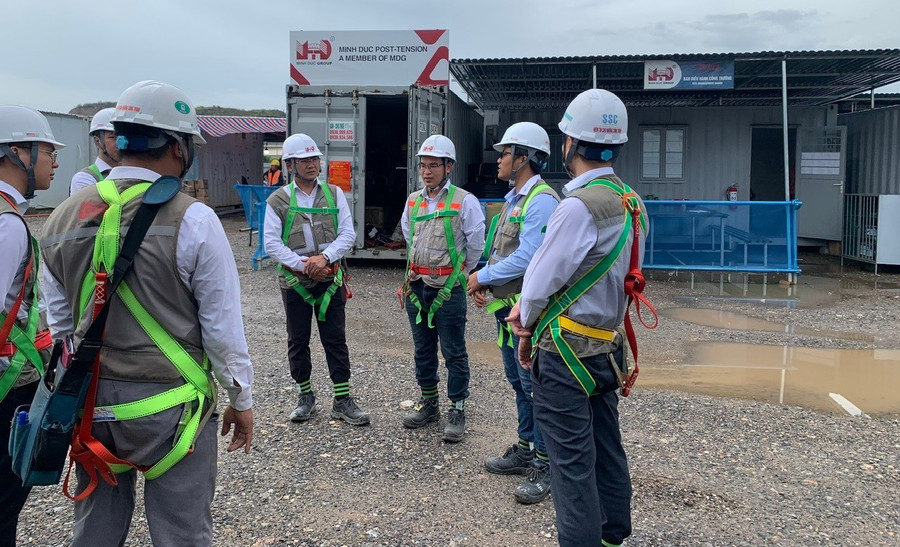
Mr. Tran Dai Nghia (4th from left), Director General of Minh Duc Construction Group, discussing with engineers at the construction site. Photo: NVCC
However, these institutions are still facing significant challenges, ranging from infrastructure limitations, investment costs, and faculty capabilities to an incomplete legal framework.
Promoting Technology Application
Since the beginning of the 2025–2026 academic year, the Ho Chi Minh City International College has officially applied AI in management and teaching to improve training quality and meet the practical demands of digital transformation in education.
Mr. Nguyen Dang Ly, the college's Rector, stated: "During the summer break, we organized training for all staff, employees, and lecturers on AI applications. Prior to this, the school established a core faculty committee to research and practice AI applications in lectures, student management, and office work optimization."
Furthermore, the college has partnered with a technology firm to develop a student management application that tracks students from enrollment to graduation. This app allows lecturers and administrators to monitor learning progress, helps parents stay updated on results and attendance, and enables early detection of students at risk of dropping out.
From there, the school coordinates with parents to identify root causes and support students in overcoming difficulties, thereby minimizing dropout rates. Additionally, the application provides reminders for tuition payment deadlines and schedule changes, while flagging weak modules to help students take a more proactive approach to their studies.
"By applying AI in management and teaching, the school is like conducting an in-depth diagnosis to identify students' strengths and weaknesses. From there, we can build appropriate lectures and approaches," added Mr. Nguyen Dang Ly.
"Industries are currently undergoing a strong digital transformation; applying AI helps save costs and improves work precision and efficiency. Therefore, learners who are exposed to modern technology early will reduce retraining costs for businesses and increase employment opportunities after graduation," said Mr. Tran Dai Nghia, General Director of Minh Duc Construction Group, from a business perspective.
In reality, many young workers entering the market still lack practical skills and process-oriented thinking, forcing businesses to retrain them from scratch, which directly affects work progress. In the Construction industry, when technology is integrated into teaching, students get the opportunity to access virtual construction site simulations and safety training. This helps them visualize potential situations and integrate into the workforce quickly.
In the construction industry, incorporating technology into teaching provides students with access to virtual site simulations and occupational safety training. The learning process does not require them to excel right from the start, but rather to master the fundamental procedures. As a result, when transitioning into the real world, students can already visualize potential scenarios and quickly integrate into the workplace.
"In the past, students' skills depended heavily on individual lecturers, with each teacher employing different methods, leading to inconsistent graduate quality. Today, applying technology in teaching ensures more synchronized training, with standardized simulations and processes. This allows learners to identify exactly where their limitations lie and which steps they missed, enabling timely corrections," emphasized Mr. Tran Dai Nghia.
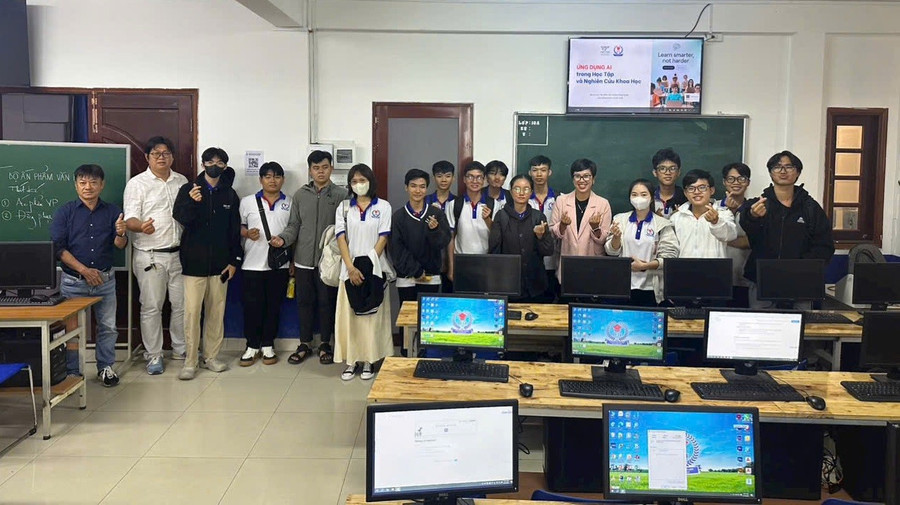
Ho Chi Minh City International College applies AI to teaching. Photo: NVCC
Challenges: From Infrastructure to Human Resources
To apply AI technology to teaching, the Hanoi College of High Technology proactively requested budget allocations from the city to invest in infrastructure. While facilities generally meet modern teaching requirements, the biggest difficulty remains the lack of uniformity in student learning devices, which hinders software installation. Additionally, legal documents regarding organizational activities in the digital environment remain unclear.
Meritorious Teacher, Dr Pham Xuan Khanh, the college's Rector, shared: "There is currently no reasonable guidance on recognizing online training forms, making it difficult to organize fully online training or coordinate with businesses."
Similarly, Mr. Nguyen Dang Ly noted that many lecturers are still stuck in old ways and find it hard to adapt to new technologies, while the costs of infrastructure investment are quite high, limiting the deployment of technology applications.
To address these challenges, the Hoa Sen Vocational College has linked up with many businesses and technology companies to create opportunities for students to practice and access modern technologies.
Mr. Le Thien Huy, the college's Rector, stated: "It is not enough to rely solely on the school's budget to purchase technology and invest in infrastructure. Therefore, to allow students and lecturers to access new technologies, we must cooperate with businesses. I hope that ministries, departments, and international organizations can also support non-public schools. This will help schools have more resources to invest in facilities and improve training quality."
"Applying AI in teaching helps lecturers proactively improve their pedagogical and research capabilities. When technology is brought into virtual reality classrooms, diverse labs, and online learning management systems, students become more engaged, and the learning environment becomes more interactive and creative," concluded Mr. Le Thien Huy.
Source: Giao duc va Thoi dai Newspaper