
Zero to Hero: When Conflict Becomes a Stepping Stone to Success
Surpassing dozens of teams from the capital's top prestigious universities, the OCT Team—comprised of five students from the Thuyloi University—became the Champions of the "Mechanically Stabilized Earth Wall" (MSE Wall) competition, delivering a highly convincing journey to victory.
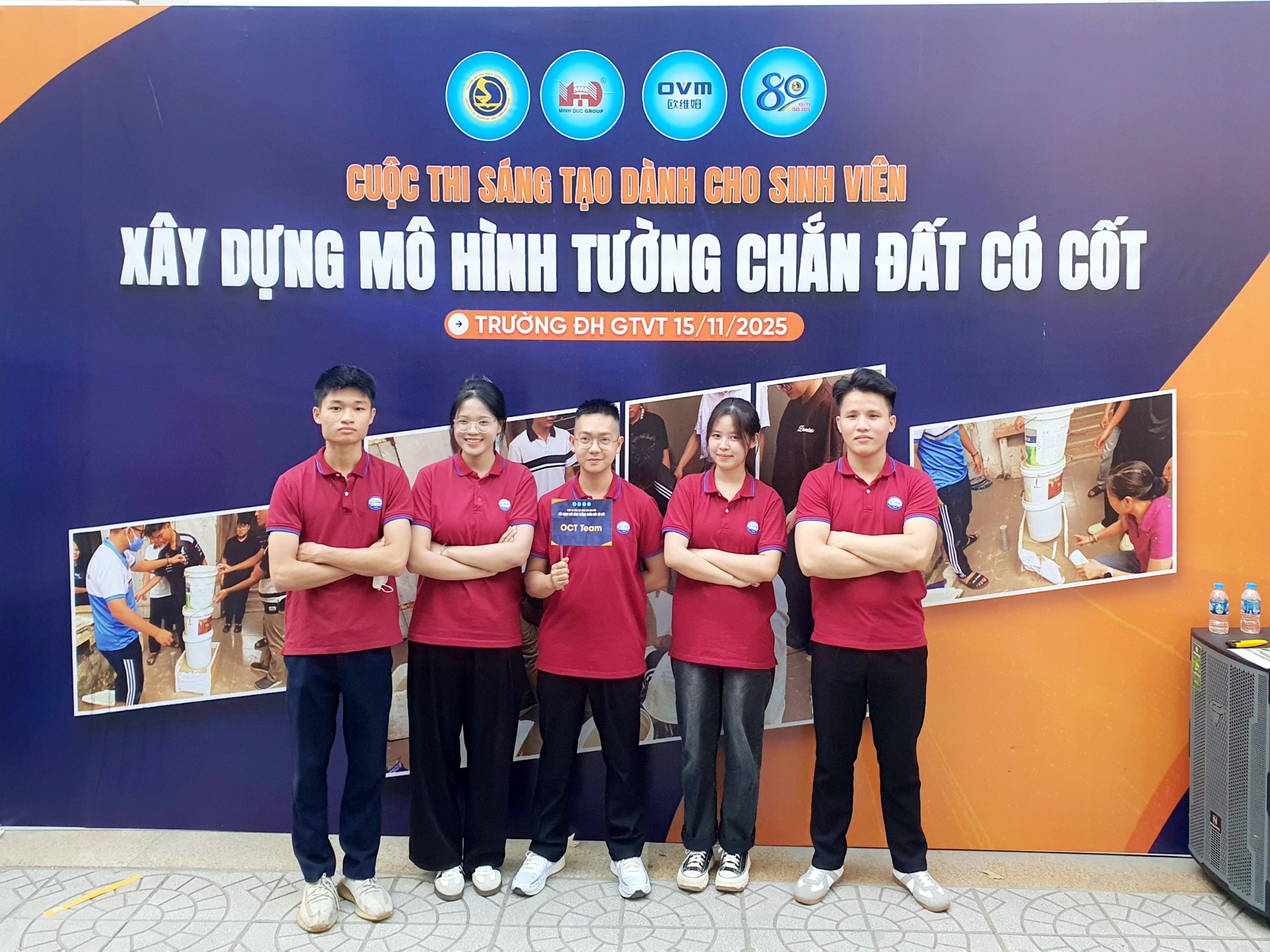
OCT Team from Thuy Loi University won the 'Reinforced Soil Retaining Wall' competition.
Behind this achievement lies the passion of five young people for research, science, and the construction industry—a field often perceived as dry, but one that actually demands great flexibility, adaptive thinking, and on-site problem-solving skills. To these Thuy Loi students, a great project is never created by a single outstanding individual, but is the result of solidarity and seamless coordination.
The construction industry is not dry at all; it requires immense flexibility.
Could you share the moment the OCT Team was formed? What connected the members to each other and led them toward the "Mechanically Stabilized Earth Wall" (MSE Wall) competition? What does the name "OCT Team" mean?
First, we would like to explain the meaning of our name, OCT Team: it stands for the "Soil Mechanics Olympiad Team" of Thuyloi University. All our members are participants from the Thuyloi University Soil Mechanics Olympiad team, having achieved high results in the National Soil Mechanics Olympiad.
Why did you decide to join forces for the "Mechanically Stabilized Earth Wall" competition?
All members of the OCT Team are individuals who have excelled in the National Soil Mechanics Olympiad. The long days of hard study together and our shared passion for the subject were the strongest bonds that connected us.
Moreover, we did not want to stop at theoretical knowledge from textbooks or written exams. When our team leader, Nguyen Quang Huy, shared information about the "MSE Wall" competition, the whole group decided to challenge ourselves and apply our knowledge to a practical engineering problem.
What was the team's initial idea for the wall model, and how did you turn that idea into a proposal more unique and creative than other teams?
Right from the beginning, the group identified this as a completely new challenge with many difficulties. Therefore, the OCT Team's first strategy was to prepare as methodically and carefully as possible. In addition to systematizing the fundamental knowledge from lectures, we proactively expanded our research scope through specialized documents and diverse references.
However, what made the OCT Team's proposal unique compared to other teams was our thorough investment in the testing phase. We did not just stop at theoretical calculations; we conducted numerous repeated experiments to directly observe the bearing capacity and deformation of the model in reality. This helped us identify issues that theory could not cover. Based on the assessments and lessons learned after each test, we continuously improved to arrive at the final, most optimal solution.
Throughout the process, from ideation to completing the model, the team must have faced many challenges. Could you share the most difficult story the OCT Team encountered and how you handled it?
The journey from concept to final model was a series of challenging days. If we had to name the biggest difficulty, it would be the fiery debates due to differing opinions.
In the early stages, the team encountered technical failures repeatedly: the model would collapse when the board was pulled, or the wall face would bulge, or it would fail under slight load increase. It was during these deadlocked moments that conflicts began to erupt.
The problem was that each person had their own reasoning. When discussing reinforcement dimensions, anchor length, or soil compaction methods, one opinion would be countered by another, and everyone was determined to defend their perspective. There were times when group meetings reached a total stalemate.
The difficulty was compounded by the fact that our class and exam schedules did not align. There were periods when only 2–3 members had to work extremely hard to carry the team, while internally, we still hadn't agreed on a solution, making the working atmosphere tense and pressurized.
Facing the risk of the team falling apart, we had to sit down and be frank with each other. We agreed: No more arguing with empty words; everything must be proven through experimentation. Anyone with an idea had to put it to a practical test, and we would fix errors where they appeared. Seeing the real results on the model helped everyone automatically lower their ego and accept others' valid points to reach the goal together.
This competition was not just an academic project, but also an opportunity for us to apply our knowledge to reality. For you, what changed your perspective on the construction industry through this competition?
For the OCT Team, this competition was truly a major turning point that completely changed our mindset about the construction industry. Previously, as students accustomed to theory-based research, we focused entirely on numbers and formulas. However, when entering the competition, we realized that: In reality, a good solution does not lie solely in numbers calculated on paper, but more importantly, in its feasibility and effectiveness during actual construction. The construction industry is not dry at all; it requires immense flexibility to handle on-site situations—something textbooks cannot fully teach. The competition taught us how to balance design thinking with practical skills, and simulation data with experimental results.
A great project is never created by a single outstanding individual.
If you could choose only one thing, what do you think is the core value the OCT team learned—not from formulas or models, but from the teamwork process itself?
Coming to the competition with the core values of Thuyloi University: "Solidarity - Integration - Pioneering - Spreading," if we had to choose the most essential one, we would choose "Solidarity." However, the true value behind those two words is: "Learning how to listen and harmonize individual egos to aim for common success."
It can be said that all members of the group have relatively strong professional foundations and have competed in many contests, so everyone had their own perspectives and arguments.
During the working process, we often engaged in intense debates to defend our ideas. But through each stage, we realized that: For the "OCT boat" to go far, we do not need "stars" shining alone, but rather pieces that know how to self-refine to connect with each other. We have learned to listen calmly to opposing opinions, learned to accept that our own solution might not be the most optimal, and understood that everyone has their own unique value to contribute to the collective.
How does that lesson affect your future career path and life?
We believe this lesson will be an invaluable asset. The construction industry is a specialized technical field that requires extremely high collective coordination. A great project is never created by a single outstanding individual, but is the result of seamless coordination between hundreds, or even thousands of people. Knowing how to lower one's ego to listen, understand, and collaborate with colleagues is the key for us to integrate and develop sustainably in any situation.
When the name "OCT Team" was called out for the Championship, how did you and the team feel at that moment?
The moment the name OCT Team was called out for the highest position was truly a moment of joy that the group will never forget. All the suspense, anxiety, and sleepless nights with the model seemed to disappear, leaving only pride and extreme happiness. We looked at each other and understood: All the group's efforts had been rewarded worthily.
What message do you want to send to other students—those who are nurturing dreams but are still afraid of challenges—as well as your gratitude to the Organizing Committee for creating such a meaningful season?
We want to send a message to fellow students: "Do not let knowledge sleep on paper." We are often afraid of failure, afraid that we are not good enough, but in reality, there is no school better than immersing oneself in challenges; all difficulties are opportunities to help ourselves mature. Do not fear being wrong, because the mistakes in the laboratory today will help us avoid risks on the construction site tomorrow. Be bold and challenge yourself, because the result is not as important as what you learn after that journey.
Once again, the OCT Team would like to express our deepest gratitude to Minh Duc Group for coordinating with the University of Transport and Communications to organize such a professional and meaningful competition. We sincerely thank the Organizing Committee for dedicating much heart, time, and resources to create an intellectual, practical, and incredibly valuable playground for students. Not only does it provide an opportunity to learn, but the competition also helps us experience reality, challenge ourselves, and mature after each step.
We believe that the values the competition brings will continue to spread, contributing to nurturing passion and inspiring many generations of future engineers. Wishing the competition to expand its scale, grow strongly, and continue to become a solid launching pad for students pursuing the construction industry.
How do you evaluate the support and companionship of Minh Duc Group and partners in creating such a practical playground for students?
Regarding the support and companionship of Minh Duc Group and partners, we want to express our deepest thanks.
Firstly, we sincerely thank the Group for their concern and investment in organizing a large-scale and highly practical playground for students. For the OCT Team, stepping out of the lecture hall to approach a practical competition is a very rare opportunity. Thanks to Minh Duc Group, we had the chance to gain practical experience, to be wrong, and to correct it right on a physical model.
Secondly, we highly appreciate the enthusiastic support from the technical team and the Organizing Committee throughout the competition. From the first days of brainstorming ideas to completing the product, whenever the group encountered technical obstacles or needed equipment support, the Organizing Committee guided and created maximum conditions for us. It was that close attention that gave us great motivation, helping the group confidently overcome all difficulties and challenges.
Finally, we would like to thank the partners and the Jury for working very impartially. The frank comments and feedback not only helped us perfect our entry to win the First Prize this time, but they are also valuable professional lessons that will stay with us forever. This award is a great recognition, but the maturity we gained after the competition is the greatest gift the Group has given us.